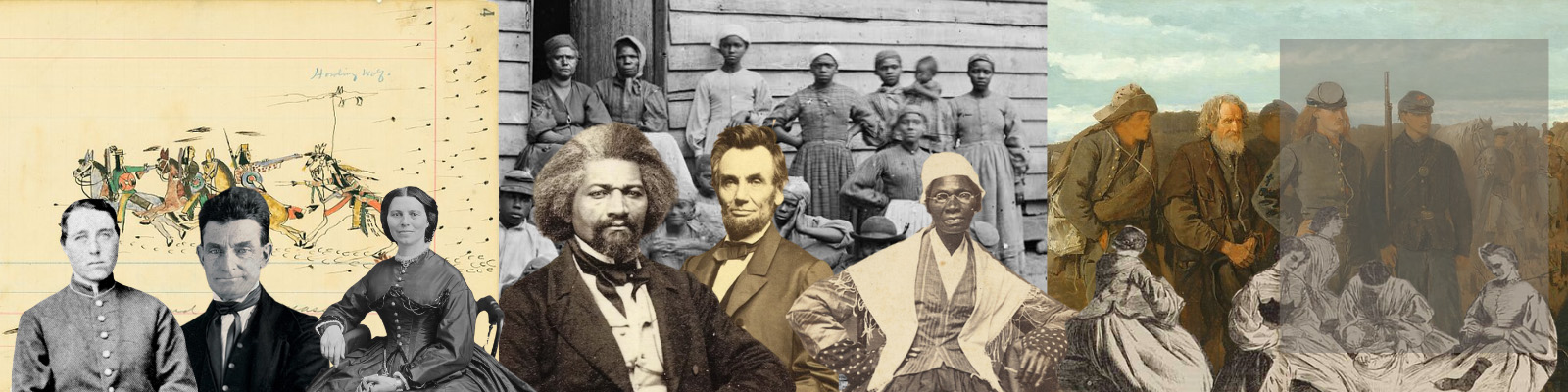
Collage of historical images and cartoons of the American Civil War

Visual Culture of the American Civil WarA Special Feature of Picturing US History

Juanita (Diné) in Native dress and blanket with weaving implements, and Governor William Frederick Milton Arny

Juanita (Diné) in Native dress and blanket with weaving implements, and Governor William Frederick Milton Arny

Source: Bell, Charles Milton, Juanita (Navajo) in Native dress and blanket with weaving implements, and Governor William Frederick Milton Arny, Platinum print, 1874, printed 1900, Amon Carter Museum of American Art, Fort Worth, Texas, https://www.cartermuseum.org/collection/juanita-navajo-native-dress-and-blanket-weaving-implements-and-governor-william.

Date: 1874

Text/Transcription:

In late 1863, the United States uprooted about 10,500 Dinés (Navajo) and Ndés from their homes in Dinétah. The government displaced them to Hwééldi (Bosque Redondo), an internment camp on the Pecos River in southeastern New Mexico. After four years of starvation, disease, and death, they accepted the Treaty of 1868, and moved to a 3.4-million-acre reservation in what is now northeastern Arizona and northwestern New Mexico.

The photograph highlights Juanita, a Diné woman, posing with the territorial governor of her Nation, William Arny. Juanita and her husband, the Diné Chief Manuelito, helped to negotiate the Treaty of 1868. In 1874, Juanita traveled as part of an official tribal delegation to Washington to meet with President U.S. Grant. In the photo, Juanita and Arny observe her loom, on which she has created a version of the American flag. Half of the textile depicts the American flag, and the other half is an "eye-dazzler" named for its bright colors. Diné women began weaving eye-dazzlers only after accessing brightly colored yarns manufactured after 1868.